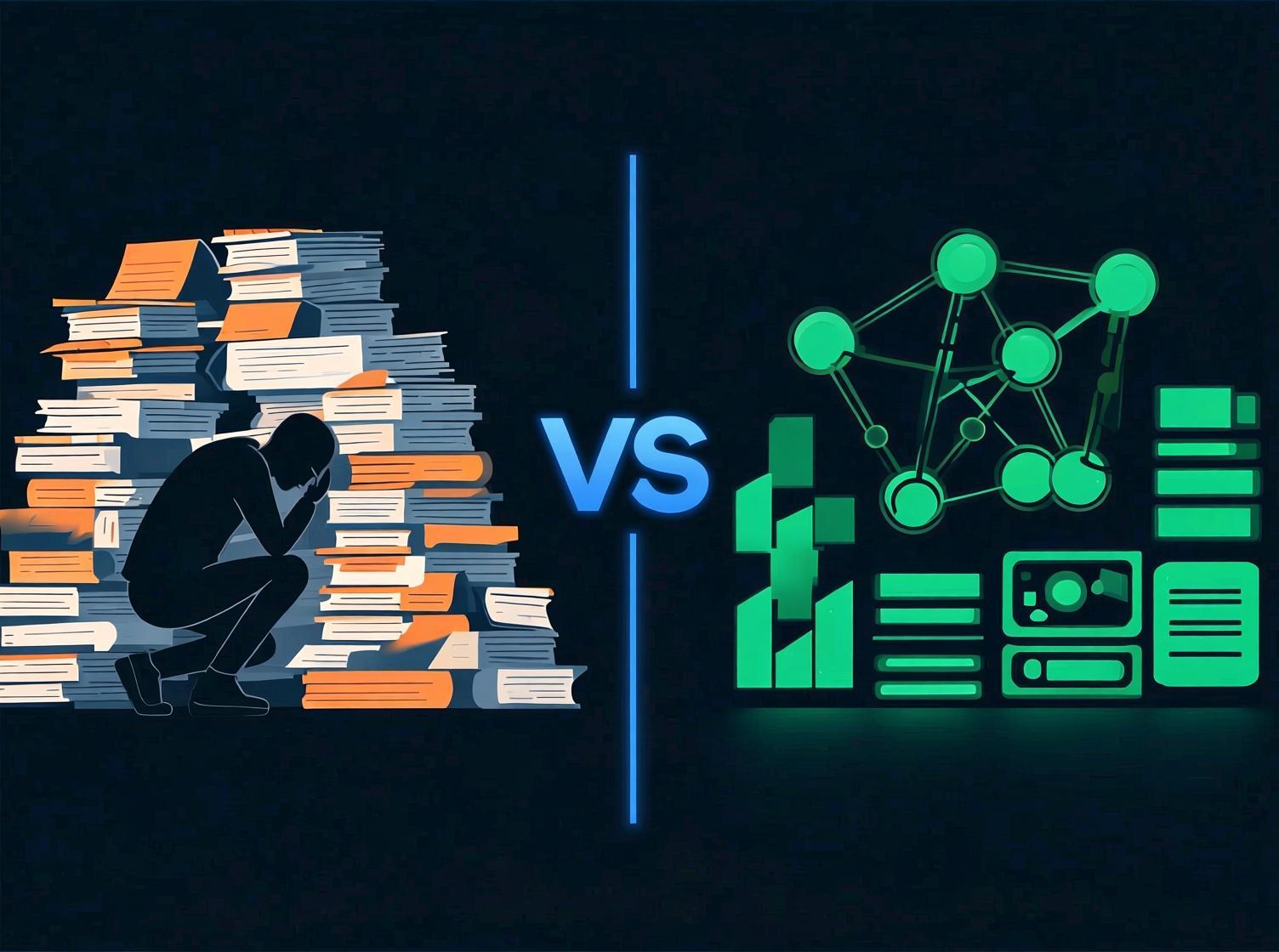
NeedSonar vs Manual Reddit Research: Which Actually Saves You More Time?
A solo founder reading 200 Reddit threads to validate one product idea sounds diligent. In practice it is a tax you pay for not having better tooling. In a 2024 survey of 312 indie hackers, 68% reported spending more than 10 hours on manual community research before writing a single line of code, and only 14% felt the research meaningfully changed what they built. The remaining 54% built what they had already decided to build, then used Reddit to confirm it.
That is the real cost of manual research. It is not just the hours. It is the bias, the recency skew, and the temptation to stop when the comments finally agree with you. This post compares NeedSonar against manual Reddit research across five dimensions that actually matter, walks through a real validation scenario, and ends with a simple rule for when to use which.
The 5-row comparison
| Dimension | Manual Reddit Research | NeedSonar |
| --- | --- | --- |
| Speed | 10 to 40 hours per idea, depending on depth | 1 to 3 hours from signup to scored report |
| Cost | $0 in tools, $0 to $200 if you pay a VA | $0 free tier, $29 to $99 per month paid |
| Coverage | The 5 to 20 subreddits you happen to know | Reddit, Hacker News, V2EX, Twitter, Product Hunt, Indie Hackers, Dev.to, Lobsters in one query |
| Bias | Heavy recency bias, heavy subreddit bias, heavy confirmation bias after 30 minutes of reading | Bias is reduced because clustering and sentiment scoring happen across thousands of posts at once |
| Repeatability | Low. Each founder re-reads the same threads and gets different takeaways. Findings are not stored in a queryable form | High. A saved query reruns on the same dataset, and you can re-score after you change your ICP filters |
"I spent two weekends reading /r/saas and /r/entrepreneur. By Sunday night I was sure my idea was great. Two months later I had three paying users. I wish I had used a tool that showed me how many other founders were building the same thing." - u/saas_lonely
Worked example: validating scheduling software for solo lawyers
Imagine you are a solo founder considering a scheduling product aimed at solo lawyers. You have worked in legal tech, you know Calendly is too generic, and you suspect solo attorneys are frustrated with the status quo. The question is whether the pain is loud enough and frequent enough to build a real business around.
Path A: the manual approach
Week 1. You subscribe to /r/lawyers, /r/LawFirm, /r/solofirm, /r/consulting, and a handful of Facebook groups. You sort by top, year, and read the top 200 posts in each. You copy every complaint that mentions scheduling, intake forms, or client communication into a spreadsheet. You read every comment thread for nuance. You flag the posts that complain specifically about Calendly, Clio, or MyCase.
Week 2. You run 40 keyword searches inside those subreddits: "Calendly alternatives lawyer", "client intake form solo attorney", "after-hours scheduling law firm", and so on. You repeat for Clio Grow, Lawmatics, and PracticePanther. You look for posts that mention a specific competitor by name and read those threads end to end.
Week 3. You skim 20 threads on /r/fatFIRE, /r/RealEstate, and /r/consulting to see whether adjacent professionals express similar pain. You write a one-page summary. You ask three lawyer friends for gut feedback. You feel 60% confident the idea is good.
Total: roughly 25 to 35 hours. Cost: $0 in tools, $0 in cash. Coverage: 4 subreddits plus a few adjacent communities, weighted heavily toward the English-speaking, US-licensed subset of /r/lawyers. Bias: enormous, because you read /r/lawyers first and watched your confidence climb with each thread.
Path B: the NeedSonar approach
Hour 1. You sign up. You enter a search query like "scheduling software solo attorney intake form" and select the law, professional services, and SaaS industries. You turn on cross-language translation and the pain-intensity filter. The crawler pulls fresh posts from Reddit, Hacker News, V2EX, Twitter, and Product Hunt, and runs AI clustering on the result.
Hour 2. You open the dashboard. You see 1,400 posts clustered into 12 themes. The top three themes, ranked by pain intensity score, are: (1) intake forms that look unprofessional and lose clients, (2) after-hours scheduling that requires a real human, and (3) Calendly's lack of legal-specific compliance language. You click into each cluster and read 10 representative posts, plus the AI summary of what is actually being complained about.
Total: roughly 2 hours. Cost: free tier covers this, otherwise a paid plan. Coverage: 10 platforms, multilingual, with sentiment scoring on every post. Bias: substantially lower, because you did not pick the subreddits in advance and the clustering forced you to look at all 12 themes, not just the three that confirmed your hunch.
What you actually learn from each path
The manual approach taught you the vocabulary lawyers use, which is genuinely useful when you write your landing page and sales emails. It also introduced you to /r/solofirm, which has a higher concentration of solo attorneys than /r/lawyers does. Those are real wins.
The NeedSonar approach taught you that the loudest pain is not "scheduling" but "intake forms that look amateur." That is a different product. It also surfaced 8 mentions of Lexicata and 4 mentions of SoloSuit, two competitors you had never heard of, and a cluster of 60 posts from non-US lawyers whose pain points are different because their intake rules differ.
If you only had time for the manual research, you would have built "a better Calendly for lawyers." If you only used NeedSonar, you would have skipped the cultural learning and the warm intros you got from three lawyer friends. The most useful question is therefore not which tool is better, but which you should start with.
The decision rule
Use manual Reddit research when you are exploring a new domain for the first time and you need to learn the language, the players, and the cultural norms before you can write a useful query. Plan for 10 to 20 hours over one to two weeks, and stop as soon as your notes start repeating themselves.
Use NeedSonar when you already know the domain and you want to quantify pain, find unmet needs, and benchmark against the existing solutions in a few hours. It is the right tool for the second pass, when you need a defensible answer to "how big is this pain and who else is building for it."
The fastest path for most founders is both: spend a weekend on manual reading to learn the domain, then spend two hours in NeedSonar to confirm or challenge what you heard. Skipping the second step is how you end up with three paying users.
"Manual research is great for learning. Automated research is great for deciding. Doing only one is how you get stuck." - u/research_robot
If you are at the point where you need a number, not a vibe, Try NeedSonar free and run your first query in the next 20 minutes.